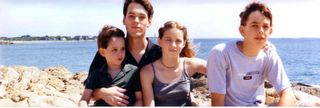
9/25/2001: Robin, Sean, Jessie, Cam

Sunday, November 08, 2009

Medley of snaps

Another miscellany/catch-all/hodgepodge/medley of snapshots...

To paraphrase Huck Finn: "...persons attempting to find a [narrative in the album below] will be prosecuted; persons attempting to find a moral in it will be banished; persons attempting to find a plot in it will be shot."

Most are snaps of nearby Annisquam (probably our favorite spot in the world), followed by a potpourri of photos of forever friends, and newlyweds Sean & Duyen, among others.


Annisquam


Robin, Jessie, Allison, Duyen


Jessie, Duyen, Robin


View of Annisquam Light from below Squam Rock.


Mom & Dad Lovell


Allison & John


Duyen


Robin


Annisquam Light from pasture


Annisquam Light, midway pasture


Family, Annisquam Light


Jessie in a cleft granite seat


Sean & Duyen's Gloucester wedding

After the church wedding, some photos from Rockport's Long Beach...


Duyen


Jessie & mom Allison


Sean & Duyen


Robin, Cameron, Sean & Duyen, John & Allison, Jessie


Family & friends


Allison, niece/cousin Jewelea, Jessie, Robin


Edithe, John, Allison, Mark


John, brother Jim


Cameron, proud Mom Allison


John's 58th, July 17 2009


Cam, Christmastide, 2008


Goofing: Cam, Rob, Sean


Cam & Mom, Aunt Peggie leading the way. Wisconsin, June 2009


Rockport Memorial Day Parade, 2008


Robin w/xylophone


Robbie, a quick rest


Oldies


John, best friend Jim, Labor Day, 1980, Gloucester's Round The Cape race


John, Robert Hanlon, winter 1978


Wedding day, 1980: Jim & Louise Rotholz


Wedding day, 1981: John & Allison Lovell


John, Essex MA


John, New Hampshire


John, Robert Hanlon, New Hampshire


New Hampshire


Jim, Lanesville MA


Wedding day, 1980: Allison's sister Jennifer Lyon


John, Louise Rotholz


John (w/Smokey), Jim Rotholz (w/Ivan)


Allison & John, Louise, Jane, Martha, Abby


Wedding day, 1980: Jim & Louise, Rockport Country Club

Saturday, November 07, 2009

Robert Frost's "Directive", 1948

A magnificent poem.
Directive
Back out of all this now too much for us,
Back in a time made simple by the loss
Of detail, burned, dissolved, and broken off
Like graveyard marble sculpture in the weather,
There is a house that is no more a house
Upon a farm that is no more a farm
And in a town that is no more a town.
The road there, if you’ll let a guide direct you
Who only has at heart your getting lost,
May seem as if it should have been a quarry—
Great monolithic knees the former town
Long since gave up pretense of keeping covered.
And there’s a story in a book about it:
Besides the wear of iron wagon wheels
The ledges show lines ruled southeast-northwest,
The chisel work of an enormous Glacier
That braced his feet against the Arctic Pole.
You must not mind a certain coolness from him
Still said to haunt this side of Panther Mountain.
Nor need you mind the serial ordeal
Of being watched from forty cellar holes
As if by eye pairs out of forty firkins.
As for the woods’ excitement over you
That sends light rustle rushes to their leaves,
Charge that to upstart inexperience.
Where were they all not twenty years ago?
They think too much of having shaded out
A few old pecker-fretted apple trees.
Make yourself up a cheering song of how
Someone’s road home from work this once was,
Who may be just ahead of you on foot
Or creaking with a buggy load of grain.
The height of the adventure is the height
Of country where two village cultures faded
Into each other. Both of them are lost.
And if you’re lost enough to find yourself
By now, pull in your ladder road behind you
And put a sign up
CLOSED to all but me.
Then make yourself at home. The only field
Now left’s no bigger than a harness gall.
First there’s the children’s house of make-believe,
Some shattered dishes underneath a pine,
The playthings in the playhouse of the children.
Weep for what little things could make them glad.
Then for the house that is no more a house,
But only a belilaced cellar hole,
Now slowly closing like a dent in dough.
This was no playhouse but a house in earnest.
Your destination and your destiny’s
A brook that was the water of the house,
Cold as a spring as yet so near its source,
Too lofty and original to rage.
(We know the valley streams that when aroused
Will leave their tatters hung on barb and thorn.)
I have kept hidden in the instep arch
Of an old cedar at the waterside
A broken drinking goblet like the Grail
Under a spell so the wrong ones can’t find it,
So can’t get saved, as Saint Mark says they mustn’t.
(I stole the goblet from the children’s playhouse.)
Here are your waters and your watering place.
Drink and be whole again beyond confusion.

Franz Wright's "The Only Animal"

Allison & I have loved this poem since we first found it in the New Yorker years ago now.

Franz Wright reads it at: NPR.


The Only Animal

The only animal that commits suicide
went for a walk in the park,
basked on a hard bench
in the first star,
traveled to the edge of space
in an armchair
while company quietly
talked, and abruptly
returned,
the room empty

The only animal that cries,
that takes off its clothes
and reports to the mirror, the one
and only animal
that brushes its own teeth

somewhere
the only animal that smokes a cigarette,
that lies down and flies backward in time,
that rises and walks to a book
and looks up a word
heard the telephone ringing
in the darkness downstairs and decided
to answer no more.

And I understand,
too well: how many times
have I made the decision to dwell
from now on
in the hour of my death
(the space I took up here
scarlessly closing like water)
and said I'm never coming back,
and yet

this morning
I stood once again
in this world,
the garden
ark and vacant
tomb of what
I can't imagine,
between twin eternities,
some sort of wings,
more or less equidistantly
exiled from both,
hovering in the dreaming called
being awake, where
You gave me
in secret one thing
to perceive, the
tall blue starry
strangeness of being
here at all.

You gave us each in secret one thing to perceive.

Furless now, upright, My banished
and experimental
child

You said, though your own heart condemn you

I do not condemn you.


Tuesday, November 03, 2009

Growing up in southern California


4th Grade, El Centro Elementary School: I'm in the middle of the back row.


My 40th high school reunion came and went this summer--Allison and I hoped to go, but couldn't. In preliminary emails we were asked to "briefly describe what it was like, growing up as a teenager in Southern California." Here's what I jotted back:

Everything's so terribly half-remembered!--and (to steal from book titles) those teen years in the '60s were both "days of heaven" and "chronicles of wasted time!" Here's a short history.

I mostly relished the '60s--I realized even then that I basked in all sorts of beauty right there around me--physical, intellectual, spiritual--the palms, magnolias, eucalyptus, bougainvillea--hummingbirds, a fish pond, my dog Kim in the backyard--the architecture of El Centro, SPJHS, the Plunge--swimming, skating--biking to the Arroyo and all round town with my little brother Jimmy. The joys of playing piano, reading wonderful books in and out of school, the thrill the first time I heard the Beatles over a transistor radio as I biked home from SPJHS. The steadfast, uncomplicated loyalty of school chums and caring teachers taught me so much about (steady, good-humored) human kindness--I realized later this was pretty much Augustine's "to be faithful in little things is a big thing"...

And yet and yet and yet--the sad effects of divorce continued to cascade into my teen years--troubled, unsteady, ungainly in some ways--though through it all I was mostly happy. The '60s--what an eclectic confluence: I was a kid with buckteeth, braces and glasses--loved his folks and couldn't wait to leave; enthralled with the Gospels, the beach and Beach Boys; reading Kierkegaard, Huck Finn; loving the Boy Scouts, hiking the mountains, mile swim in Catalina; poolside Saturnalia; playing B football, lobbing Salvo detergent into the SM pool with the guys; loving Chopin, Wolfman Jack--the strange, joyous unpatterned mix of things that growing up still entails, I suppose.

Wednesday, October 14, 2009

Nuptial

A poem for Duyen's birthday, August 27th...


Your first year together
a few short days ago--
my son's eyes mirror
the deep, arresting
joy in your eyes,
his beloved. Your heart
beats for joy, God's
joy that pulses true
and full, now into our family.
A year has passed--you first
breezed to this shore,
then off to another--then (unexpectedly
as a wave crashing early) too soon
to another--heartsick, homeward. Praise
to God for you, for your own
mother's heart, your own father's song,
your own voice, laughing, confident,
trembling with joy. Praise.

Thursday, June 11, 2009

Billy Collins: The Lanyard

Former poet laureate Billy Collins reads his poem The Lanyard, video clip here.

The Lanyard

The other day as I was ricocheting slowly
off the pale blue walls of this room,
bouncing from typewriter to piano,
from bookshelf to an envelope lying on the floor,
I found myself in the L section of the dictionary
where my eyes fell upon the word lanyard.

No cookie nibbled by a French novelist
could send one more suddenly into the past --
a past where I sat at a workbench at a camp
by a deep Adirondack lake
learning how to braid thin plastic strips
into a lanyard, a gift for my mother.

I had never seen anyone use a lanyard
or wear one, if that’s what you did with them,
but that did not keep me from crossing
strand over strand again and again
until I had made a boxy
red and white lanyard for my mother.

She gave me life and milk from her breasts,
and I gave her a lanyard.
She nursed me in many a sickroom,
lifted teaspoons of medicine to my lips,
set cold face-cloths on my forehead,
and then led me out into the airy light

and taught me to walk and swim,
and I, in turn, presented her with a lanyard.
Here are thousands of meals, she said,
and here is clothing and a good education.
And here is your lanyard, I replied,
which I made with a little help from a counselor.

Here is a breathing body and a beating heart,
strong legs, bones and teeth,
and two clear eyes to read the world, she whispered,
and here, I said, is the lanyard I made at camp.
And here, I wish to say to her now,
is a smaller gift--not the archaic truth

that you can never repay your mother,
but the rueful admission that when she took
the two-tone lanyard from my hands,
I was as sure as a boy could be
that this useless, worthless thing I wove
out of boredom would be enough to make us even.

Sunday, May 17, 2009

Almost unmade

A recent book review in the New Yorker made me appreciate the simple, spare language (& ancient antecedents) Gerard Manley Hopkins uses to capture what life's about.

From Gerard Manley Hopkins' Wreck of the Deutschland, c. 1875:
Thou mastering me
God! giver of breath and bread;
World’s strand, sway of the sea;
Lord of living and dead;
Thou hast bound bones and veins in me, fastened me flesh,
And after it almost unmade, what with dread,
Thy doing: and dost thou touch me afresh?
Over again I feel thy finger and find thee.

Snippet from Cædmon's Hymn, c. 660:
Now we must praise / heaven-kingdom's Guardian
the Measurer's might / and his mind-plans,
the work of the Glory-Father, / when he of wonders of every one,
eternal Lord, / the beginning established.

Tuesday, May 05, 2009

1838: Trail Where They Cried (Nunna dual Tsuny)


Allison's great-great-grandmother was a Cherokee who survived the travesty of the Trail of Tears--a heartbreaking time for a courageous, heartening people who sang hymns as they were forced along:
In 1838, in one of the best remembered incidents of the Removal of Natives from the American Southeast, sixteen thousand Cherokees were forcibly marched nine hundred miles from Georgia to present-day Oklahoma. One-fourth of the Cherokee Nation died along the route that came to be called the Trail of Tears. As they walked, Christian Indians among them sang Christian hymns in their own language. The best known of these was an atonement hymn, "One Drop of Blood," which asks, "Jesus, what must I do for you to save me?" The reply is, "It only takes one drop of blood to wash away our sins. You are King of Kings, the Creator of all things." The Cherokee translation of "Guide Me, O Thou Great Jehovah," also sung on the trail, is equally poignant:

Take me and guide me, Jehovah, as I am walking through this barren land.
I am weak, but though art mighty. Ever help us..
Open unto us thy healing waters. Let the fiery cloud go before us and continue thy help.
Help us when we come to the Jordan River and we shall sing thy praise eternally

Source, Google Books: Jace Weaver's Other words: American Indian literature, law, and culture. UOP, 2001, p. 280.
There is additionally this snippet from the article: Among the Cherokee Indians, 1824, p. 224:
There are several hymns in the Cherokee language, which our dear friends sing almost constantly. We sing in Cherokee at night when the school closes. The Lord is visiting this nation in great mercies. I have witnessed what my weak faith hardly ever dared to expect...
Google Books is a rich repository of early 17th-, 18th-, and 19th-century accounts of Cherokee history and faith, here.

It's a reminder to remember and treasure the love, faith, endurance of a great-great-grandmother at this time of year in a late May now so long ago.

Monday, May 04, 2009

Stu Hackett

I've recently stumbled across some online appreciation for the esteemed--more than that, the beloved--Stu Hackett. He, his wife Joan and the Hackett family have graced so many of our lives for so long now--with keen wit, bright intelligence, humility and lovinge kyndnesse.

The three links below serve in some fashion to inform that love and appreciation.


1. The interactive Hackett: an appreciation of Stu Hackett: works (even his monumental The Resurrection of Theism), witticisms, quotations.

2. A wonderful reflection from William Craig Lane, here.

3. A glimpse at Stu's cordial, good-humored wit:
Stu Hackett, used to tell us the story of a teacher of his who once answered a student's question about the generic use of the word 'Man' by stating that, "As a rule, 'Man' embraces 'Woman'." The smart-alecky kid who asked the question then said something like, "Yeah, in more ways than one!" Stu always got a kick out of telling us that story.
Source: here.

Though no longer at hand (I've recently given it to a dear friend) one of Stu's marvelous--and early--essays was in C.F.H. Henry's The Word for This Century, OUP, 1960--detailed here.

Saturday, April 25, 2009

Magnificent

A hurried aside: we're taken with the U2 song Magnificent. Last month's performance of the song in Boston is posted on the U2 site.

Lyric:

Magnificent
Magnificent

I was born
I was born to be with you

In this space and time

After that and ever after I haven't had a clue

Only to break rhyme
This foolishness can leave a heart black and blue


Only love, only love can leave such a mark

But only love, only love can heal such a scar


I was born
I was born to sing for you

I didn't have a choice but to lift you up
And sing whatever song you wanted me to
I give you back my voice
From the womb my first cry, it was a joyful noise ...

Only love, only love can leave such a mark

But only love, only love can heal such a scar


Justified till we die, you and I will magnify

The Magnificent

Magnificent


Lyric source: here.

Friday, April 24, 2009

J.N. Findlay


I discovered a wonderful tribute to a professor I had long ago--brought back wonderful memories--here's a snippet, and a link to the site.


Findlay "in 1978 he was well into his 70s, a short, round, balding man with a South African accent and an unmanageable wisp of white hair at the top of his head. He dressed in oversized, boxy, faded grey and black suits that at the time appeared to be 20 or 30 years old. He would lecture (on Husserl , Hegel, Kant, Plato, Wittgenstein, and Axiology) in a room with six blackboards, writing out each of his words as he spoke them, frantically filling the boards. When he completed the sixth blackboard he would race back to the first, erase it and begin writing again, until he was completely out of breath and his suit, hands and face were covered with chalk dust."

The full tribute is here.

Saturday, April 18, 2009

Robert Burns: Ae Fond Kiss

Wonderful (2006) rendition of Robert Burns' Ae Fond Kiss (1791). Lyric here.


Here's a lovely variant version from 2009.

Sunday, March 22, 2009

"Don't know much about history..." - Part I


(Forgive the frivolous HT to Sam Cooke's lyric to Wonderful World...!)

As part of a workplace project I've been scanning through databases of historical documents from 1770 on.

I've found some scant but fascinating material there and via Google Books with some mention of the Lanesville Congregational Church--our church in Gloucester. Here are two snippets from 1856--I love the mention of "nothingarians" and "this sea-faring people"!

From Annual Report of the Massachusetts Home Missionary Society
By Massachusetts Home Missionary Society
Published by Press of T.R. Marvin, 1856


"27. Lanesville.—We give the pastor's own account of an important feature of the prosperity of this church and society, premising that, in the early history of religious services here, everything had the most discouraging aspect. Religious error had almost undisputed possession of the field, and all the early years of evangelical service were years of anxious, and of but feebly successful, labors. But we give the record of a pleasing change. " The greatest encouragement of this year has been the successful completion of a new meeting house, and the entire payment of the expenses by ourselves. The edifice cost about nine thousand dollars, is neatly and thoroughly furnished, and was joyfully dedicated to God in January last. Besides paying for the pews, we have carpeted the church, and obtained the Sabbath Hymn Book at a cost of five hundred dollars. The people have cheerfully straitened themselves to erect such a tasteful and commodious house of worship. Since its erection, our congregation has averaged twenty-five more each Sabbath, and the Sabbath school has increased considerably. Quite a number of purchasers are Universalists and nothingarians, and many have found their way to meeting who were never seen there before. In all this, we feel that God has greatly blest us, and that he will yet give a spiritual increase much larger. For this Christians are praying. The temperance cause has greatly flourished, eighty-six persons have taken the Washingtonian pledge. There is not a rum or beer shop in the place."

"27. Lanesville.—Rev. Mr. Burgess left this field in September last, and has-been succeeded by Rev. Thomas Morong, who has entered upon his work with great earnestness, and with encouraging prospects of success. There are many obstacles among this sea-faring people to the spiritual progress of the gospel; but our missionary seems disposed to make a vigorous experiment to ascertain the gospel's power to save the souls of that people. He' speaks of many encouragements: " Good and increased attendance on public worship; growing interest in the weekly prayer-meeting; the quiet religions feeling which has been manifested among the unconverted ; respectful attention among the young; increased contributions to aid in supporting the gospel and for benevolent purposes ; the softening down of prejudice against our church and doctrines."

"Don't know much about history..." - Part II

Another find--a single instance in A College of colleges of remarks by H.C. Trumbull--the esteemed author of Hints on Child Rearing (1890) and great-grandfather to our beloved TH and his siblings.

From A College of colleges. T. J. Shanks, Dwight Lyman Moody, 1887.
Mr. Henry Clay Trumbull :
I want to emphasize the suggestion that you would do well in reading any text of Scripture to be sure that you know the meaning of the words themselves, for unless you do, you are not likely to understand the precise meaning in which any of them is used in the connection in which you find it. I remember a man in North Carolina twenty years ago who preached a sermon from the text, "Lo, I come." "'Low," said he; "not high. The Lord Jesus comes to the poor and lowly." Some one wrote to me not long ago and asked: "Please tell us in what sense the word fire is used in our English Bible." After looking into the matter I said in reply that there were at least thirteen words translated by the English word fire, and in the Old Testament the range of meaning of these words is very wide. Take again one word we are using constantly—the word "amen"—in prayer. What does that word mean? There is one thing it does not mean: "So let it be." It does not mean that, no matter what any dictionary, abridged or unabridged, may say. Going back to the word itself in the Hebrew, and going yet farther to the word as it is still found in the Arabic, we find that it means "So it will be." In other words, it is not another pleading cry at the end of a prayer; it is an expression of trust in the One to whom the prayer is offered. There is a great deal of prayer without faith. I was in an insane asylum at one time—of course as a visitor. I have been in jail three times as a prisoner; but that was when Dr. Broadus and myself were not on the same platform. I remember the first time I was in battle. At the close of that day—it was the Lord's day—in the hospital, a Baptist Sunday-school teacher who was an officer in our regiment, and a South Carolina officer joined together and prayed for themselves and. for each other. Both were severely, and I think mortally wounded. Those two soldiers, who had been a few hours before in mortal combat, now joined in loving sympathy in love to Christ.
[A Voice—Tell us about Libby Prison.]
When I was in Libby Prison, an order came that one person was to be released. Every one wished and hoped that he was the one. When the inspector came in the morning and the name was called out, "Chaplain H. C. Trumbull," I can assure you I never valued my name as I did at that moment. Coming back to being in the insane asylum: There was one man there constantly asking for his dinner. He kept saying: "Dr. Butler, I wish I could have some dinner to-day. Doctor, I am afraid I shall not have any dinner. Doctor—Doctor—can't I have some dinner to-day?" "Yes, sir," said the Doctor; "you can have your dinner." "Doctor, can't I have my dinner to-day? Can't I have my dinner? Doctor—Doctor—Doctor—dinner! —dinner!—dinner! "Then the door closed. Now that was in a certain sense making known his wants, but there was none of the true spirit of prayer in it. And yet this word is used as a final cry—"So let it be." On the other hand, that one word in the Hebrew, which is really transferred to the "amen," as we have it here, is the very word employed with reference to Abraham when it is said: "And he believed [Hebrew word here] in the Lord, and He counted it to him for righteousness." I had occasion several years ago to work this out in the line of my studies. When I went to the Arabic and Syrian scholars, they declared themselves unable to give the full meaning of the word because there was so much in it. One man said when I asked him: "Well, it means so much I can hardly tell you how much it means. It means that if you so believe in a man that you lean on him, and you give yourself up wholly, and go right into him, and be a part of himself, and you will trust him because he is to be trusted, and you can't help trusting him—all that will give you some idea of what is in that word ' amen.' "At the end of a prayer in that sense, it means far more than as we ordinarily use it. I met an old soldier of the great Napoleon, and I asked him about his Emperor. "Ah," said he, "we believed in Napoleon. You Christians believe in God. We believed in Napoleon. If Emperor Napoleon say to his soldiers, 'Napoleon, go to the moon,' they would start. Napoleon fight the moon."

Saturday, November 15, 2008

Birthday poem, 15 Oct 2008


Winnowing
For Allison, my heart

Maybe it's all so simple after all. A heart hungering,
a giving up, our yearnings enfolded in a world of mercies unseen.
Rainswept we once dashed beneath the maple canopy, lips kissed--
your breath later pulsing against my neck in the dark.
One flesh, so long ago
alone, then together, twinned but one--one heart always, now rich with years.

Loving you is so joyous, deep, a true thrill at heart--a mystery no
language can ever ever capture--always faltering with each scrawled runic framing:
I only live to love you true by giving up, repeating the pledge
so long ago banding us:
I will love you with an everlasting love.
(Once my darling it circumscribed our joyous nuptial whirl amid jeweler jaunts.
Now uncomplicated as
emptying, it encircles the one brimming passion of our hearts.)

Friday, August 22, 2008

Sean and Duyen's Wedding


Hooray!--Sean & Duyen were married, 23 August 2008. We'll post photos soon.

Monday, April 28, 2008

Spring trip to Ohio Wesleyan

We had fun motoring from Rockport to Ohio Wesleyan--here are some snapshots of the trip...


Monday, March 10, 2008

..."The thing we freely forfeit"...

Apologies to Gerard Manley Hopkins: some snapshots from eons ago...


Sean, July 1991: South Pasadena JHS


John: scouts, May 1965


John: Rose Bowl parade, 1967


John: with best friend Kim, c. 1968: South Pasadena


Sean and Grandpa, July 1991: Glendale

Thursday, February 14, 2008

Robin's "A Place of Importance"

Robin wrote the few paragraphs below as a 7th-grade writing assignment. His teacher enjoyed it so much, calling it the best middle-school writing she'd seen in her years of teaching. She then listed the names of a half-dozen famous authors on the chalkboard, read Robbie's paragraphs without attribution, and asked the class to guess the author!

A Place of Importance, by Robert Micah Lovell

The path, viewed from above, looked not much different than a burnt sienna-snake trail among a yard crowded full with dark green grass, ever-twisting in a long, narrow route. It began where the rocky lane in front of our house faded into the vast ocean of tall, tired oaks that inhabited that old forest. It diverged at many places, and every different pathway that split away from the original trail would always take you to somewhere different.

My two brothers and I used to prowl among the great trails on long hikes every summer, marching proudly alongside acres of aged pine trees. Because we traveled in order of age, oldest in front, I always trailed along in the back as a follower. We explored every nook and cranny of the whole wood, and knew it almost better than we knew our very own selves. Sometimes to get away from the house every once in awhile, I would sneak out into the woods, secretly, covering my furtive footprints with every step I took. I would not do this often, for I was generally a happy boy, but the calming whistle of wind swimming across the sky was a soothing song when I was feeling melancholy.

What a view it was on the path at dawn, a slithering zephyr, that passed through the tall yellow grasses like an invisible wave in front of the setting vermilion sun. In the dirt, imprints of strangers' shoes rose into the sky with the breeze, and washed its slate clean until the new sunrise.

Even now, I visit the old trails and I listen to the wailing wind’s song, and I take the path that leads down to the river. I find a good sized walking- stick and march lively along the rugged dirt trail, but this time, only one thing is different. No, not the new tree-fort beside the river, or the fact that I hold a different stick. This difference changes the whole feeling of the march. The smell of independence now dwells in the atmosphere, because for now, I march in front.